Self Compacting Concrete (SCC)
Self Compacting Concrete (SCC)
Construction today is no longer simple. Buildings are taller, reinforcement is denser, architectural designs are more complex, and timelines are tighter than ever before. In this environment, conventional vibrated concrete often creates unnecessary risk. Improper compaction, honeycombing, uneven surface finish and costly rework are common site problems that affect both structural integrity and project timelines.
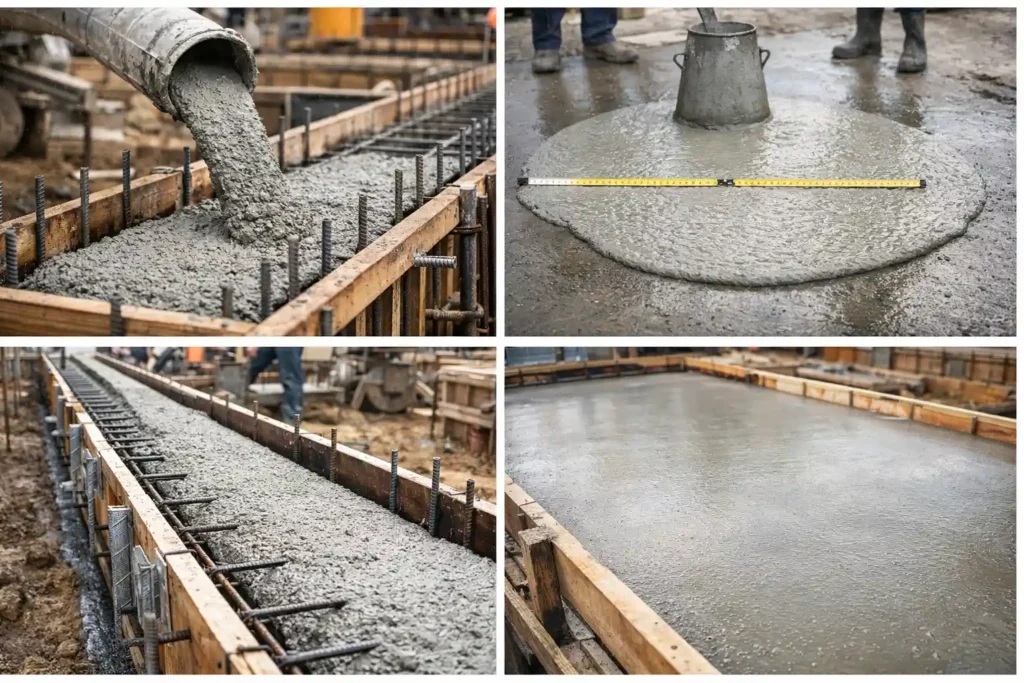
Self Compacting Concrete (SCC) is engineered to eliminate these challenges. It is a high-performance concrete that flows under its own weight, fills every corner of the formwork and passes easily through congested reinforcement without the need for vibration. The result is uniform compaction, enhanced strength and superior surface finish in a single controlled pour.
SCC is not just an alternative material. It is a strategic construction solution for projects where precision and reliability are critical.
Why Conventional Concrete Fails in Complex Structures
In heavily reinforced structural members such as shear walls, deep beams, columns and core walls of high-rise buildings, normal concrete struggles to move freely between steel bars. Mechanical vibration is required to achieve compaction, but even then, results are inconsistent. Over-vibration may cause segregation, while under-vibration leads to trapped air pockets and honeycombing.
These defects are often discovered after de-shuttering, when repairs become unavoidable. Surface patching, structural correction and delay penalties increase overall project cost and affect professional credibility. In premium or exposed concrete projects, visual defects alone can compromise client satisfaction.
Self Compacting Concrete removes this uncertainty. Its carefully designed mix ensures high flowability with stability, allowing it to completely fill the formwork and encapsulate reinforcement without mechanical assistance.
How Self Compacting Concrete Improves Project Efficiency
The most significant advantage of SCC is predictable performance. Since vibration is not required, the casting process becomes faster and more controlled. Labor dependency reduces, noise levels decrease and overall site productivity improves. For large-scale projects, even small time savings per pour can result in substantial schedule acceleration.
Additionally, improved filling capacity reduces the risk of rework. When structures are cast correctly in the first attempt, both direct and indirect costs decrease. Project managers gain confidence in structural quality, and inspection processes become smoother.
SCC is particularly valuable in:
High-rise buildings
Commercial complexes
Infrastructure projects
Industrial structures
Precast manufacturing
Where structural density and finishing standards are high, SCC consistently delivers superior results.
Performance Comparison in Real Site Conditions
The following comparison reflects practical construction scenarios:
| Construction Parameter | Conventional Concrete | Self Compacting Concrete |
|---|---|---|
| Compaction Method | Mechanical vibration required | Self-compacting, no vibration |
| Performance in Dense Reinforcement | Risk of incomplete filling | Smooth and complete filling |
| Honeycombing Probability | Moderate to High | Very Low |
| Surface Finish Quality | May require repair | Smooth and uniform |
| Labor Requirement | Higher manpower | Reduced manpower |
| Casting Speed | Dependent on vibration efficiency | Faster and consistent |
When structural complexity increases, performance reliability becomes more important than basic cost comparison.
Superior Surface Finish and Structural Integrity
Surface finish is not only about appearance. It reflects the quality of compaction inside the structure. Poorly compacted concrete increases permeability, leading to long-term durability issues such as corrosion and structural weakening.
Self Compacting Concrete enhances density and reduces void formation. This improves durability, structural strength and long-term performance. In exposed concrete applications, the smooth finish minimizes the need for plastering or corrective treatments, further reducing project costs.
For precast manufacturers, SCC ensures accurate mold replication, sharp edges and uniform surfaces without air pockets. Production speed improves while maintaining quality standards.
Economic Advantage Beyond Initial Cost
Many contractors evaluate concrete purely on rate per cubic meter. However, true project cost includes labor, equipment usage, time delays, rework and finishing corrections. When these factors are considered, SCC often proves to be more economical.
Reduced labor requirement lowers operational expense. Faster placement accelerates project milestones. Lower defect rates prevent costly repairs. These cumulative benefits create measurable financial value over the entire construction cycle.
Instead of focusing solely on material price, it is important to assess total project efficiency. In complex structures, the risk associated with conventional concrete can outweigh any apparent initial savings.
Customized Mix Design for Project Requirements
Every construction project has unique requirements. Structural load conditions, reinforcement density, environmental exposure and architectural finish standards differ from site to site. For this reason, Self Compacting Concrete can be customized based on required grade, flow characteristics and performance expectations.
Technical consultation ensures that the mix is optimized for your specific application. Whether the requirement is high-strength structural concrete or controlled flow for intricate formwork, the mix can be designed to deliver consistent and reliable performance.
Early discussion of site conditions allows proper planning and ensures smooth casting without last-minute adjustments.
When Should You Choose SCC?
Self Compacting Concrete becomes the logical choice when:
Reinforcement congestion is high
Structural sections are complex
Premium finish is required
Labor availability is limited
Project timelines are strict
In such conditions, the risk of conventional compaction methods increases. Choosing SCC reduces uncertainty and improves overall project confidence.
Make the Right Structural Decision
Concrete forms the backbone of every structure. Once cast, it cannot be replaced without major consequences. Therefore, selecting the right type of concrete is not a minor decision. It directly impacts structural strength, durability, aesthetics and overall project success.
Self Compacting Concrete offers controlled performance, reliable compaction and long-term durability. For developers, engineers and contractors who prioritize quality and efficiency, it provides a dependable solution for modern construction challenges.
For project-specific consultation, mix recommendations and supply planning, share your structural details and casting requirements. A tailored solution can be provided to ensure your project achieves both strength and precision without compromise.
Ready to Cast Without Risk?
Share your project requirements and get expert guidance on the right Self Compacting Concrete mix. Ensure smooth casting, reduced rework and structural confidence from start to finish.