
Grades M7.5 – M60
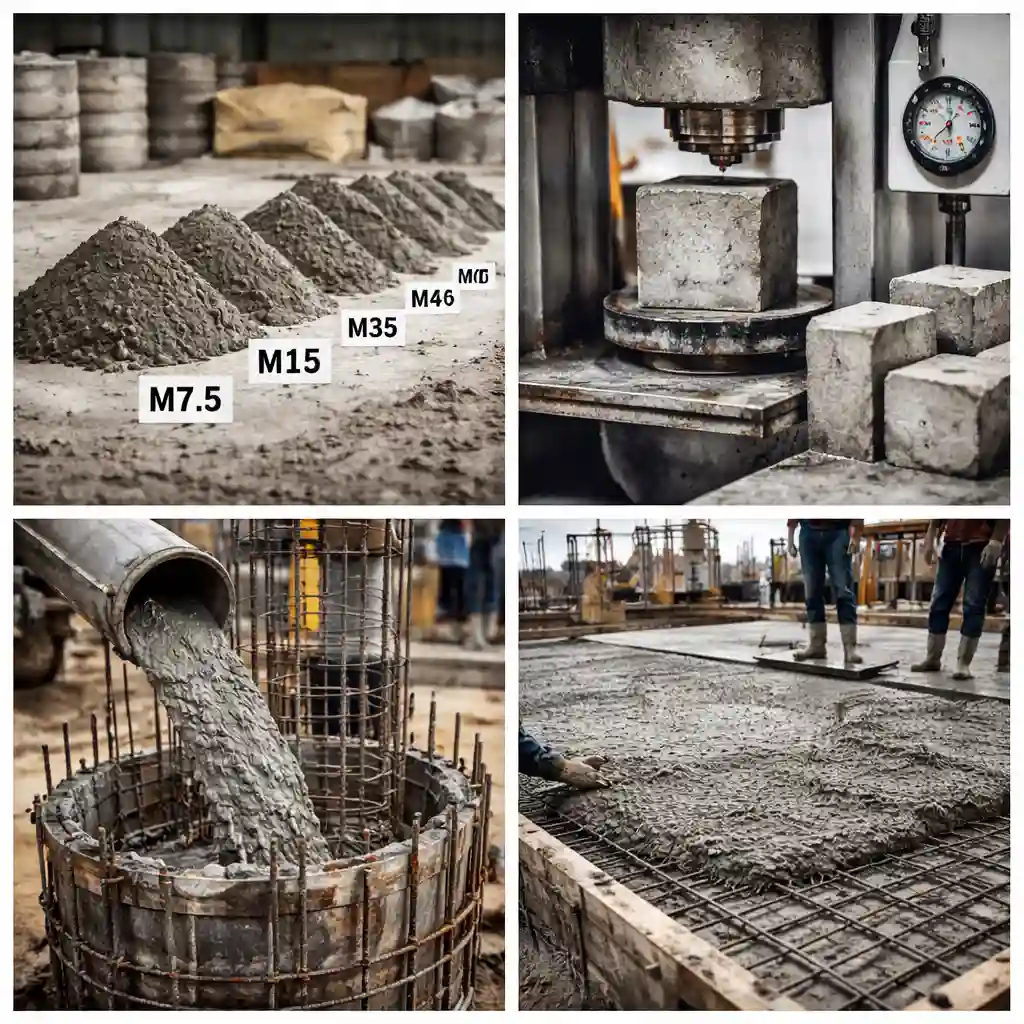
Concrete Grades M7.5 – M60
The Right Strength for Every Stage of Construction
Concrete is not a one-grade-fits-all material. Every structure has different load requirements, durability expectations and design specifications. From basic residential foundations to high-rise structural cores, selecting the correct concrete grade directly impacts safety, performance and long-term stability.
Grades M7.5 to M60 represent a complete strength range designed to meet diverse construction needs. Lower grades are suitable for non-structural or light-load applications, while higher grades are engineered for heavy-load and high-performance structures.
Choosing the correct grade is not just about strength—it is about structural efficiency and long-term durability.
Understanding Concrete Grades
Concrete grades are classified based on compressive strength measured in megapascals (MPa) after 28 days of curing. The “M” in M7.5 to M60 stands for “Mix,” and the number indicates the characteristic compressive strength.
For example:
M7.5 indicates 7.5 MPa strength
M20 indicates 20 MPa strength
M40 indicates 40 MPa strength
M60 indicates 60 MPa strength
Higher numbers represent higher load-bearing capacity and enhanced structural performance.
Applications Across Different Grades
Each grade serves a specific purpose depending on structural demand and engineering requirements.
Low Strength Grades (M7.5 – M15)
These grades are commonly used for:
Lean concrete
Leveling courses
Non-structural fillings
Pathways and minor works
They provide base stability but are not recommended for major load-bearing components.
Standard Structural Grades (M20 – M30)
These are widely used in residential and commercial construction for:
Slabs
Beams
Columns
Footings
M20 and above are typically used for reinforced concrete structures, offering reliable strength for standard building loads.
High Performance Grades (M35 – M60)
These grades are designed for heavy-duty and high-load applications such as:
High-rise buildings
Industrial structures
Bridges and flyovers
Infrastructure projects
Heavy-load foundations
Higher grades allow structural members to carry increased loads while maintaining durability and reduced permeability.
Performance Comparison by Grade Range
| Grade Range | Typical Use | Load Capacity | Structural Application |
|---|---|---|---|
| M7.5 – M15 | Lean / Non-structural | Low | Filling & Base Works |
| M20 – M30 | Standard Structural | Moderate | Residential & Commercial |
| M35 – M45 | Heavy Structural | High | Multi-storey & Commercial |
| M50 – M60 | High Strength | Very High | High-rise & Infrastructure |
Why Correct Grade Selection Matters
Using a lower grade than required can compromise structural safety and durability. On the other hand, using unnecessarily high grades increases project cost without proportional benefit.
Correct grade selection ensures:
Structural stability
Cost efficiency
Long-term durability
Compliance with engineering standards
Optimized material usage
Structural load calculation, environmental exposure and building height all influence the required grade.
Durability and Long-Term Performance
Higher grades typically offer better durability due to improved density and lower permeability. Reduced water penetration helps prevent reinforcement corrosion and structural deterioration over time.
In projects exposed to heavy loads, environmental stress or vertical expansion, higher grades provide enhanced safety margins. For infrastructure projects especially, durability plays a critical role in lifecycle performance.
Selecting the right grade at the design stage avoids costly reinforcement, repair or strengthening measures later.
Customized Supply for Project Requirements
Every construction project has unique design specifications. Whether the requirement is basic lean concrete or high-strength structural concrete up to M60, mix design must align with engineering calculations.
Proper batching, quality raw materials and controlled production ensure consistent compressive strength across supply. Timely delivery and technical coordination further support smooth project execution.
Grade selection should always be aligned with structural drawings and load calculations to ensure performance consistency.
Build with the Right Strength
Concrete defines the structural backbone of any project. From foundational layers to high-rise cores, selecting the appropriate grade between M7.5 and M60 ensures both safety and efficiency.
Instead of focusing only on immediate cost, evaluate structural demand, design height and long-term durability requirements. The correct grade selection improves overall construction quality and structural reliability.
For grade consultation, technical guidance and project-specific supply planning, share your structural requirements and load details to determine the most suitable concrete grade for your project.
Choose the Right Concrete Grade for Your Project
From M7.5 to M60, get expert guidance on selecting the correct grade based on structural load, design requirements and durability expectations. Discuss your project specifications with our technical team today.