
High Strength Concrete
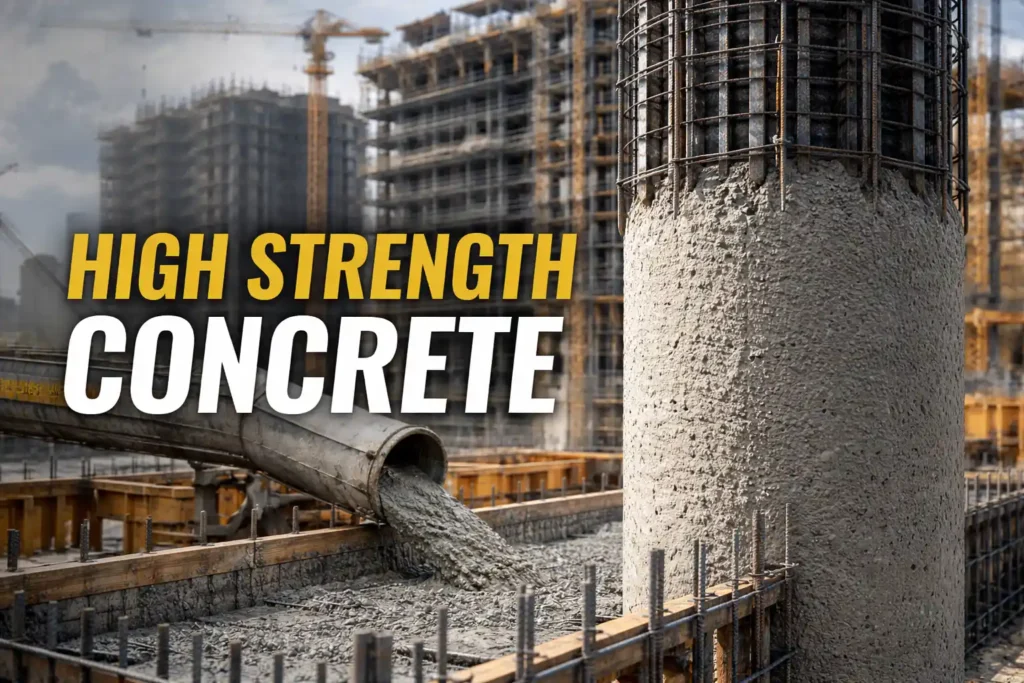
High Strength Concrete (HSC)
Built for Projects That Demand Superior Load Capacity
High Strength Concrete (HSC) is developed for structures where exceptional compressive strength and structural reliability are non-negotiable. As architectural ambitions grow and buildings rise higher, the demand for stronger, more efficient construction materials continues to increase. Standard concrete grades often meet basic structural needs, but when load intensity, vertical expansion or heavy-duty applications come into play, High Strength Concrete becomes essential.
HSC delivers significantly higher compressive strength, enabling structural members to withstand greater loads while maintaining safety, durability and long-term performance. It is specifically engineered for modern construction environments where performance cannot be compromised.
Why Higher Strength Makes a Structural Difference
In multi-storey buildings, bridges and industrial facilities, structural elements carry enormous loads. Using conventional grades may require larger columns and thicker beams to achieve required strength. This increases material usage and reduces usable space.
High Strength Concrete allows engineers to design slimmer structural components without sacrificing load-bearing capacity. Reduced column dimensions improve usable floor area in commercial and residential projects. In high-rise construction, this efficiency becomes even more valuable, as lower floors must support substantial vertical loads.
Higher compressive strength also enhances overall structural stability, reducing deformation under stress and improving resistance to extreme conditions.
Performance Advantages Beyond Strength
While compressive strength is the primary feature of HSC, its benefits extend beyond just higher numerical values. The optimized mix design enhances durability, reduces permeability and improves long-term resistance against environmental exposure.
Key advantages include:
Superior compressive strength
Enhanced structural efficiency
Lower permeability
Improved durability
Greater resistance to cracking under load
Better long-term performance
These characteristics make HSC suitable for both vertical and heavy-load horizontal structures.
Real-World Performance Comparison
Understanding the practical difference between standard and high-strength concrete helps in project planning:
| Structural Parameter | Conventional Concrete | High Strength Concrete |
|---|---|---|
| Compressive Capacity | Standard structural load | High load-bearing capacity |
| Column Dimensions | Larger sections required | Optimized smaller sections |
| Structural Efficiency | Moderate | High |
| Durability | Standard | Enhanced |
| Long-Term Performance | Adequate | Superior |
When structural demand increases, High Strength Concrete offers improved safety margins and design flexibility.
Ideal Applications for High Strength Concrete
High Strength Concrete is widely used in:
High-rise residential towers
Commercial complexes
Bridges and flyovers
Heavy industrial plants
Infrastructure projects
Load-intensive foundations
In tall buildings, HSC is often used in lower floors where compressive forces are highest. In bridges, it supports heavy vehicular loads and withstands environmental exposure. In industrial environments, it resists sustained stress and operational load impact.
For projects involving critical load-bearing components, HSC ensures structural confidence.
Durability and Long-Term Structural Protection
Strength alone does not define performance. Durability determines how a structure behaves over decades. High Strength Concrete typically has a denser microstructure and reduced permeability, limiting moisture penetration and minimizing the risk of reinforcement corrosion.
This directly increases service life and reduces maintenance costs. In environments exposed to chemicals, temperature variation or heavy traffic, durability becomes a key decision factor. HSC provides enhanced resistance against structural deterioration, offering long-term reliability.
For developers and project owners, this translates into lower lifecycle cost and improved structural value.
Customized Grade Selection for Project Needs
Every project has specific design loads and performance expectations. High Strength Concrete can be supplied in various grades depending on structural calculations and engineering specifications. Selecting the right grade ensures cost efficiency without unnecessary overdesign.
Technical evaluation of structural requirements helps determine the appropriate compressive strength, workability and curing conditions. Early planning and coordination between engineering and supply teams ensure smooth execution at site and consistent strength development.
Proper mix optimization guarantees performance consistency across large-scale pours.
A Strategic Choice for Structural Confidence
Concrete is the backbone of any structure. Once cast, it defines safety, durability and long-term performance. Choosing High Strength Concrete is a strategic decision for projects where reliability, efficiency and structural excellence are required.
Instead of focusing solely on initial cost per cubic meter, it is important to evaluate load conditions, structural design and future maintenance considerations. In demanding construction environments, HSC provides measurable advantages in strength, durability and efficiency.
For consultation, grade recommendation and project-specific supply planning, share your structural specifications and load details to determine the most suitable high-strength mix for your project.
Build Higher. Build Stronger. Build Without Compromise.
Share your structural load requirements and project specifications with our team. Get expert guidance on the right High Strength Concrete grade designed for maximum durability, efficiency and long-term structural confidence.